Ebook Looking toward Ararat: Armenia in Modern History, by Ronald Grigor Suny
The benefits to take for checking out guides Looking Toward Ararat: Armenia In Modern History, By Ronald Grigor Suny are pertaining to boost your life quality. The life high quality will certainly not simply regarding the amount of expertise you will acquire. Also you read the enjoyable or amusing publications, it will aid you to have improving life top quality. Feeling fun will certainly lead you to do something flawlessly. Additionally, guide Looking Toward Ararat: Armenia In Modern History, By Ronald Grigor Suny will provide you the lesson to take as a great need to do something. You could not be worthless when reading this publication Looking Toward Ararat: Armenia In Modern History, By Ronald Grigor Suny
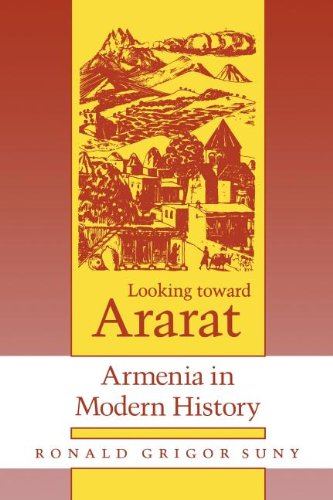
Looking toward Ararat: Armenia in Modern History, by Ronald Grigor Suny

Ebook Looking toward Ararat: Armenia in Modern History, by Ronald Grigor Suny
When you are hurried of task deadline as well as have no suggestion to get inspiration, Looking Toward Ararat: Armenia In Modern History, By Ronald Grigor Suny book is among your solutions to take. Book Looking Toward Ararat: Armenia In Modern History, By Ronald Grigor Suny will certainly give you the right resource and point to get inspirations. It is not just about the tasks for politic company, management, economics, as well as various other. Some got tasks making some fiction works additionally require motivations to conquer the work. As exactly what you need, this Looking Toward Ararat: Armenia In Modern History, By Ronald Grigor Suny will possibly be your choice.
Maintain your method to be right here and also read this web page finished. You can take pleasure in browsing the book Looking Toward Ararat: Armenia In Modern History, By Ronald Grigor Suny that you truly describe get. Below, obtaining the soft file of guide Looking Toward Ararat: Armenia In Modern History, By Ronald Grigor Suny can be done conveniently by downloading in the link resource that we offer below. Naturally, the Looking Toward Ararat: Armenia In Modern History, By Ronald Grigor Suny will certainly be all yours sooner. It's no have to await guide Looking Toward Ararat: Armenia In Modern History, By Ronald Grigor Suny to obtain some days later on after acquiring. It's no should go outside under the warms at center day to head to the book shop.
This is a few of the advantages to take when being the participant and also obtain the book Looking Toward Ararat: Armenia In Modern History, By Ronald Grigor Suny right here. Still ask just what's various of the various other website? We provide the hundreds titles that are created by suggested authors and also publishers, around the world. The link to get as well as download and install Looking Toward Ararat: Armenia In Modern History, By Ronald Grigor Suny is also very easy. You could not locate the complicated site that order to do more. So, the method for you to get this Looking Toward Ararat: Armenia In Modern History, By Ronald Grigor Suny will be so very easy, will not you?
Based upon the Looking Toward Ararat: Armenia In Modern History, By Ronald Grigor Suny information that we offer, you might not be so baffled to be right here and to be member. Get currently the soft file of this book Looking Toward Ararat: Armenia In Modern History, By Ronald Grigor Suny as well as wait to be yours. You conserving can lead you to evoke the convenience of you in reading this book Looking Toward Ararat: Armenia In Modern History, By Ronald Grigor Suny Also this is kinds of soft documents. You can really make better opportunity to obtain this Looking Toward Ararat: Armenia In Modern History, By Ronald Grigor Suny as the suggested book to check out.
As a new independent Republic of Armenia is established among the ruins of the Soviet Union, Armenians are rethinking their history―the processes by which they arrived at statehood in a small part of their historic homeland, and the definitions they might give to boundaries of their nation. Both a victim and a beneficiary of rival empires, Armenia experienced a complex evolution as a divided or an erased polity with a widespread diaspora.
Ronald Grigor Suny traces the cultural and social transformations and interventions that created a new sense of Armenian nationality in the nineteenth and twentieth centuries. Perceptions of antiquity and uniqueness combined in the popular imagination with the experiences of dispersion, genocide, and regeneration to forge an Armenian nation in Transcaucasia. Suny shows that while the limits of Armenia at times excluded the diaspora, now, at a time of state renewal, the boundaries have been expanded to include Armenians who live beyond the borders of the republic.
- Sales Rank: #1873219 in Books
- Published on: 1993-05-22
- Released on: 1993-05-22
- Original language: English
- Number of items: 1
- Dimensions: 9.25" h x .77" w x 6.12" l, .98 pounds
- Binding: Paperback
- 304 pages
From Library Journal
Suny, an established historian of this region and its peoples, examines the development and nature of Armenian identity and nationality in a series of essays written over the past several decades. From the study of nationalism and socialism among the Armenians in Russia over the past two centuries, Suny moves toward concepts of modernization, statehood, and culture under the Soviets and following the demise of the USSR. Through the discipline of the historical method and theory, the author seeks to stretch beyond the focus upon Armenians as an endangered people, a perspective expounded by the many works on the Turkish massacre of Armenians during World War I. Suny succeeds in this endeavor and offers the student and researcher a fine collection of scholarly articles for larger library collections and those specializing in the study of this area.
- Rena Fowler, Humboldt State Univ., Arcata, Cal.
Copyright 1993 Reed Business Information, Inc.
Review
" ... a fine collection of scholarly articles ... " Library Journal "Professor Suny excels in his treatment of the political and social factors affecting the development of the Armenian nation." Academic Library Book Review "This book should rapidly emerge as the most reliable introduction available to the modern history of Armenia." Central Asian Survey " ... rich in new insights and fresh perspectives ... the first major work of post-Soviet Armenian historiography." Robert H. Hewsen, American Historical Review "Considered as a whole, this book is to a substantial degree unique in its objectivity. Read reflectively ... it should contribute to the evolution of a more constructive evaluation of the Armenian predicament than has prevailed in recent decades." Russian Review
About the Author
RONALD GRIGOR SUNY is Alex Manoogian Professor of Modern Armenian History at the University of Michigan. A specialist in the history of the non-Russian peoples of the Soviet Union, he is the author of The Making of the Georgian Nation and editor of Transcaucasia, Nationalism, and Social Change.
Most helpful customer reviews
12 of 13 people found the following review helpful.
a history of one Armenia
By Seth J. Frantzman
This is a History of Eastern Armenia in the present. Easily readible. It details the history of the Armenians and especially focuses on the eastern Armenians in the Russian empire and the Soviet state. A good resource as their are so few books on the Armenians and the tragedy of the Armenian genocide. This is a topic and a people more Americans need to learn about.
9 of 10 people found the following review helpful.
Armenia rises again, and again
By Bob Newman
In the mid-19th century, Armenians had already been divided for a long time. Their traditional homeland in Anatolia was split up between three empires---Russia, Iran and the Ottomans. Most people there lived either as peasants or townsmen in forgotten corners. Another large segment of the Armenians lived in distant large cities such as Istanbul, Izmir, Isfahan, or Tiflis. The two sections did not often mix. Awareness of Armenia's history, culture and even language was at an all-time low. Inspired by the struggles and movements of other peoples, mostly in Europe, the Armenian intellectuals began to build an "identity", to create a nation where none had existed for half a millennium. Strands of socialism and Marxism wove their way through the national struggle, but they always played second fiddle to the cause of the nation. Rallying around the Apostolic Church and the ancient Armenian language with its own script, but developing strong disagreements among themselves over tactics and directions, the Armenians moved towards a nation state of their own, to be located in Anatolia. Unlike the many Balkan nationalities, the Baltics, Israel, and indeed Italy and Germany too, the Armenians were doomed to failure. Taking advantage of the chaos of World War I, some nationalists demonstrated and fought for a new Armenia, to arise on the ashes of the Ottoman Empire. The idea backfired and led to genocide. The remnants of the Anatolian Armenians, if they did not flee south to Arab cities, to North America or Europe, wound up in a corner of historic Armenia that remained under control of Russia. After a two year period of independence, that Armenia became part of the Soviet Union. Suffering the vicissitudes of life in the USSR, but transformed into an urban, literate, and nationalistic society, Armenia finally re-emerged on the world stage in 1991, impoverished and embattled once again.
Suny's book on Armenia in Modern History deserves high marks for trying to avoid the nationalistic slant that disfigures so many "modern histories". As he himself notes, "the field of Armenian history is marked by unquestioning nationalism, narcissism, and ethnic-pride boosting." Challenging the accepted mythology always makes interesting reading and LOOKING TOWARDS ARARAT is no exception. Suny concentrates on the Armenians of Anatolia and the Caucasus---those who lived further away from the traditional homeland appear only in passing. The book has three themes: the nature of Armenian-ness and the "idea" of Armenia, the struggle to create an Armenian state, and the transformation of the Armenian people from peasants and urbanites in diaspora to an urban, industrial, literate people living in a truncated-but-viable national state. Two issues that are also discussed are the genocide (Chap. 6) and the events that led to a) Armenia's separation from the USSR and b) the war with Azerbaijan in the 1990s. The author covers this last part in blow-by-blow detail. Other than the glaring lack of a good map, I have only praise for this book and for the author in trying to cross through what is no doubt a minefield of angry nationalist opinion. I learned a great deal and can recommend the book to anyone who is seriously interested in the topic. It isn't bedtime reading. It's academic, but still the most useful, well-written book I've found that deals with modern Armenian history.
2 of 5 people found the following review helpful.
Bad translation and leaving much to be desired.
By Yoda
This book leaves much to be desired, especially considering that it was published by a reputable scholarly press (Indiana University). The translation is bad, there are maps with errors (many are not accurate and cannot even be properly used) and there are many errors (i.e., typos, etc.) that a good editor should have been more than able to correct. Related to the bad translation (and probably stemming from it) the book is poorly read and hard to follow.
Although this problem is not severe, there are others that are more severe. One of them is the the sources for much of the history come primarily from the Soviet Union. This is not much of a surprise considering Armenia's location but the problem is that much research (and sources) outside of the Soviet Union (i.e., Lebanon, University of Paris, etc.) are not even touched upon. This is a shame considering both the volume and quality.
If one is interested in a history of Armenia, especially from an academic press, one can do much better, especially considering the plaethora of books published on the topic in the past few years. Even Palgrave's History of Armenia (written for layman and published by a non-academic press) is far better. Skip this book and choose something else. Even if you randomly pick something on the topic you are bound to do better than this book.
Looking toward Ararat: Armenia in Modern History, by Ronald Grigor Suny PDF
Looking toward Ararat: Armenia in Modern History, by Ronald Grigor Suny EPub
Looking toward Ararat: Armenia in Modern History, by Ronald Grigor Suny Doc
Looking toward Ararat: Armenia in Modern History, by Ronald Grigor Suny iBooks
Looking toward Ararat: Armenia in Modern History, by Ronald Grigor Suny rtf
Looking toward Ararat: Armenia in Modern History, by Ronald Grigor Suny Mobipocket
Looking toward Ararat: Armenia in Modern History, by Ronald Grigor Suny Kindle

Tidak ada komentar:
Posting Komentar